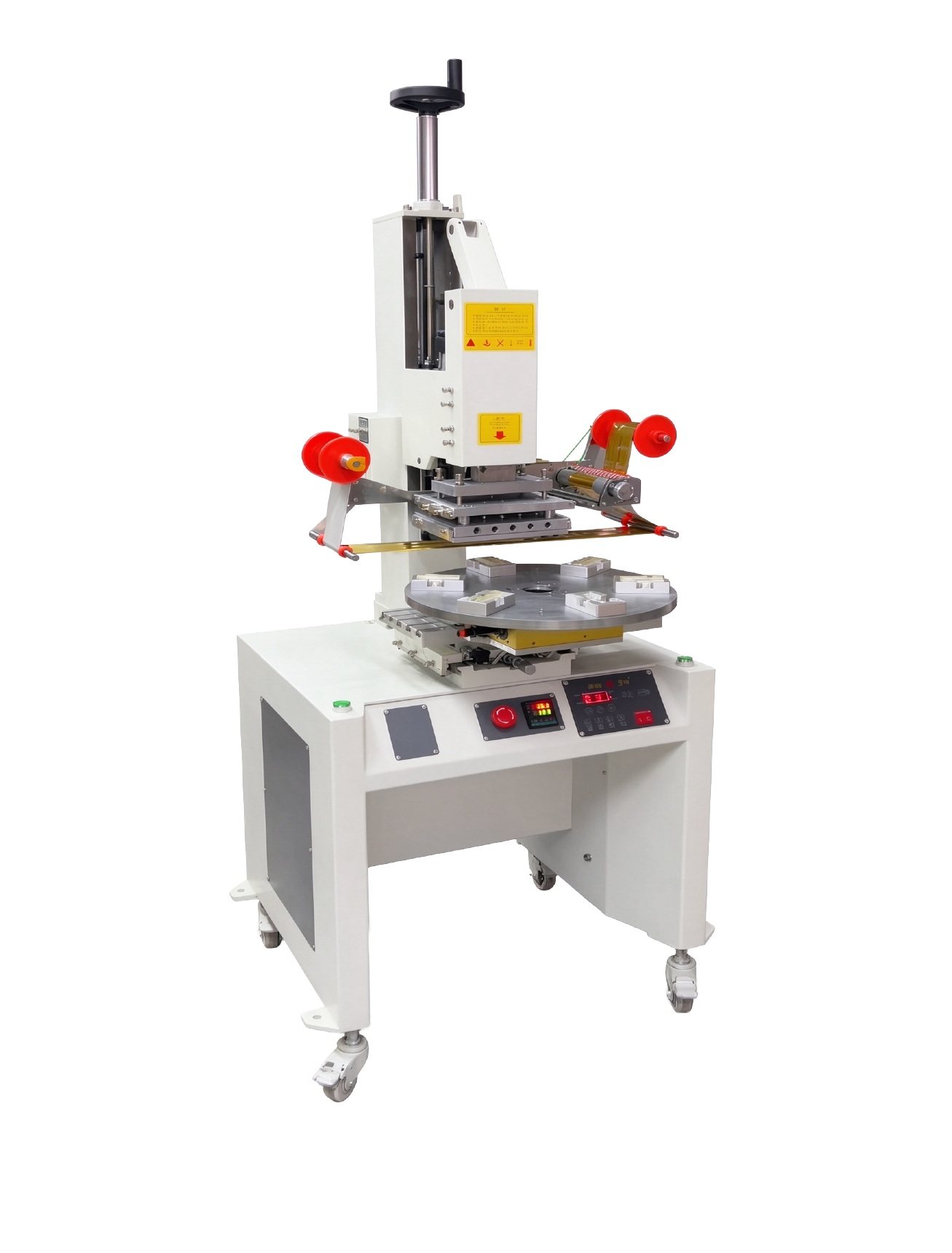
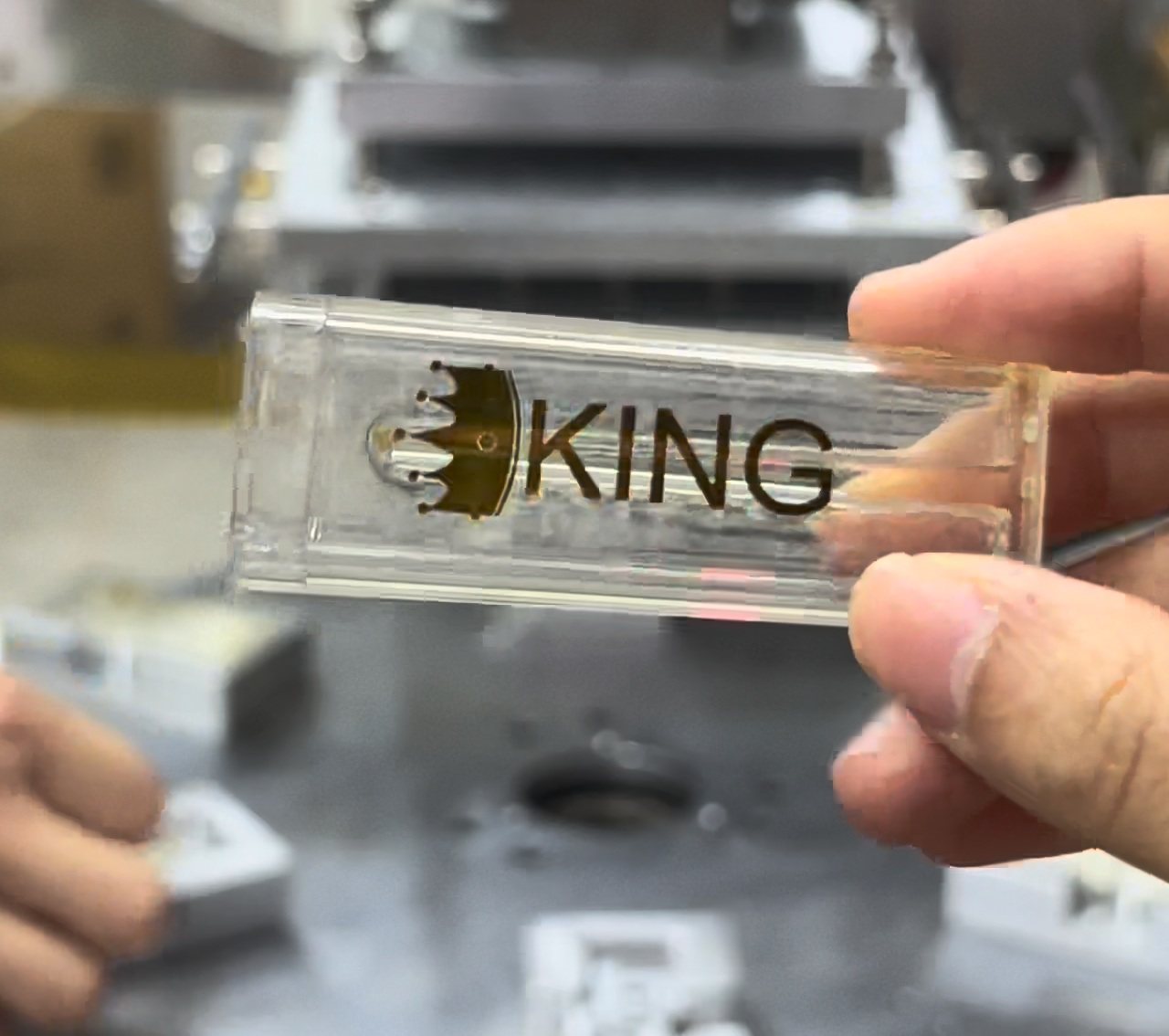
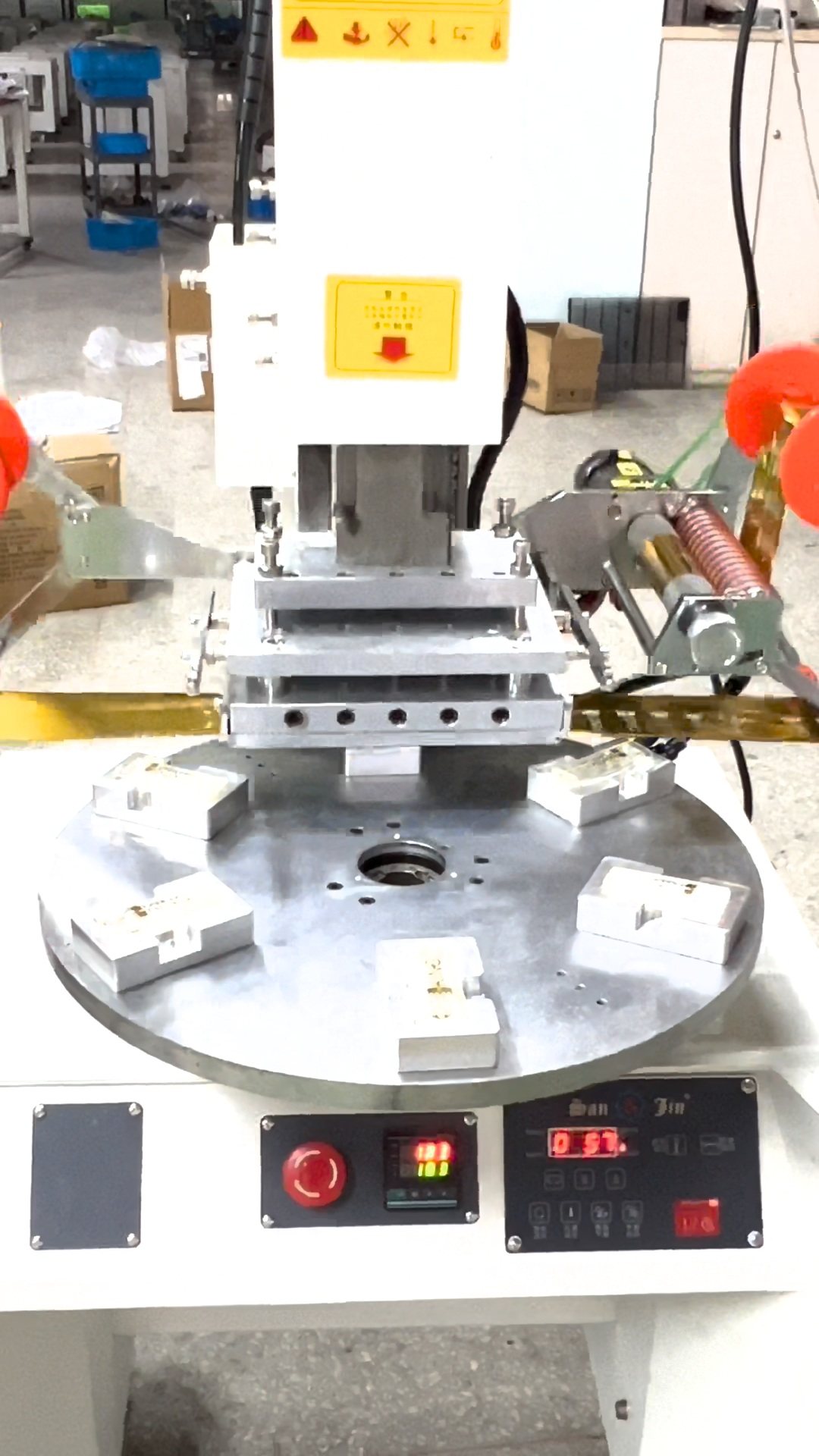
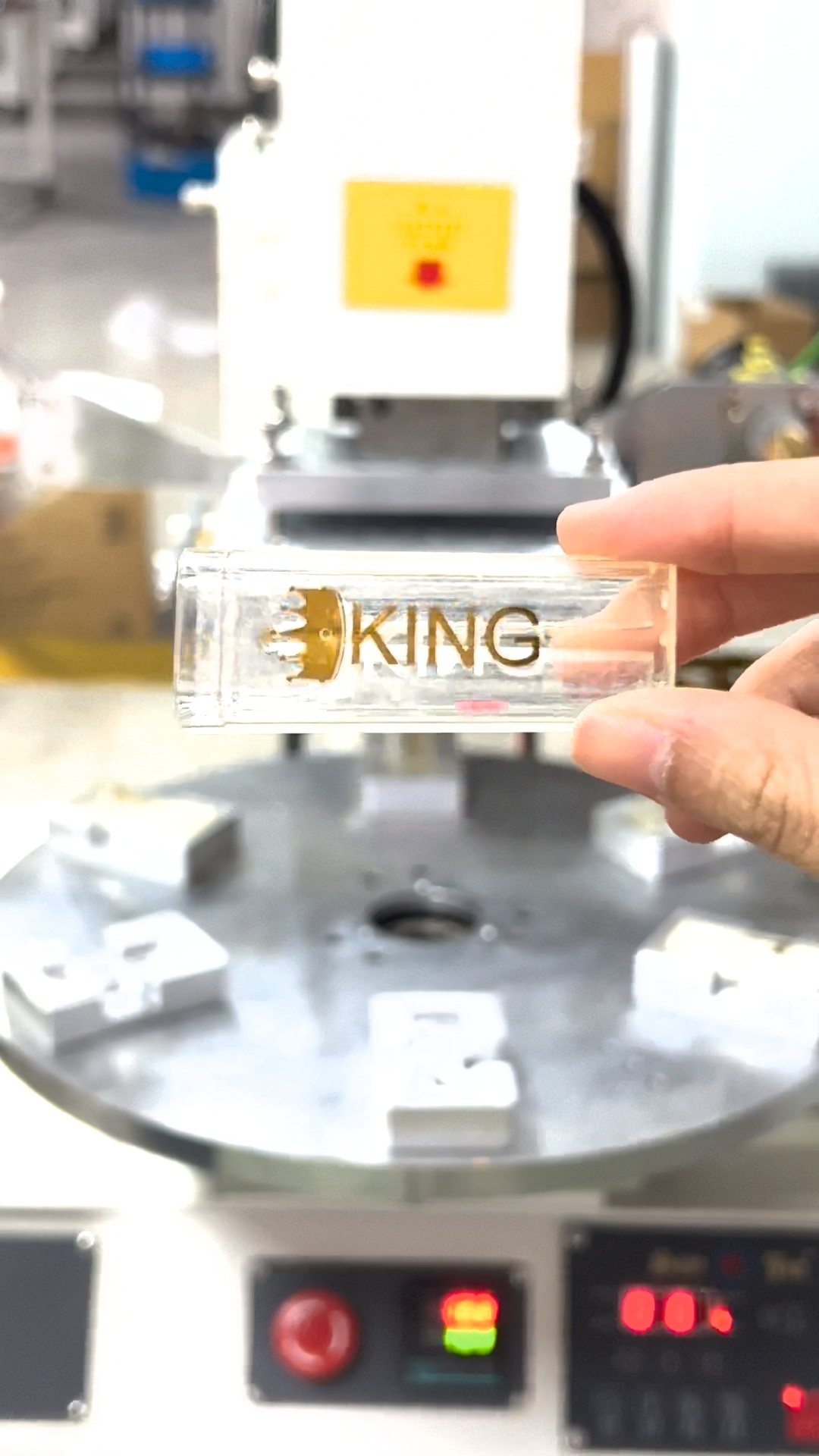
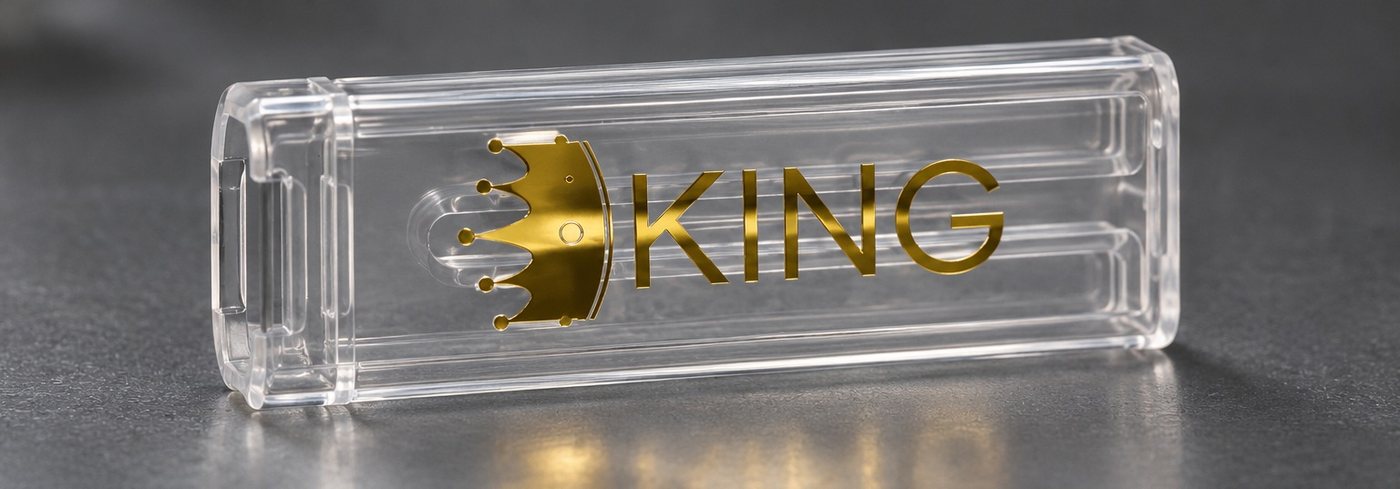
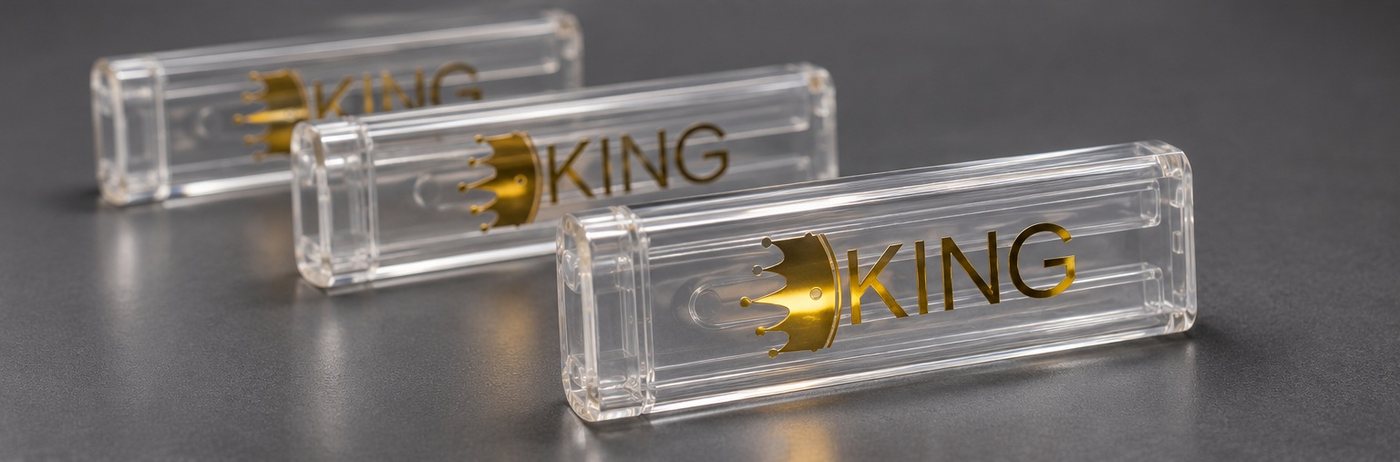
Hot foil stamping is a decoration process that transfers a metallic or colored foil onto a compatible product surface using heat, pressure and a suitable contact time. This application demonstrates the SANJIN H195BZ rotary table hot stamping machine applying a gold crown and KING lettering to a transparent lighter shell. The workshop video shows the machine in operation, the rotary table moving the parts through the stamping position, and the actual decorated shell.
For repeated production of small parts with consistent dimensions, a rotary table offers a practical alternative to a single fixed worktable. Several product fixtures move sequentially into the stamping position, allowing loading and unloading to be organized at appropriate positions instead of repeatedly occupying the same work area. This helps reduce idle time associated with manual handling, while dedicated fixtures support consistent product positioning. The H195BZ has a rated standard stamping speed of 1,600 pieces per hour. Actual output depends on loading, fixture design, stamping time and the product material.
For a transparent plastic shell, the foil, stamping die and fixture should be evaluated together. Heat-sensitive materials may require particular care to avoid deformation or cosmetic damage. Sample testing should establish whether the intended artwork transfers cleanly, whether the shell remains intact and whether the foil adhesion meets the application requirements. The product should be an appropriate empty shell, not a fueled or ignitable assembly. SANJIN can assess the application from product dimensions, material information, artwork and sample parts. The real video and actual result photograph document this demonstration; additional rendered images illustrate possible visual presentation rather than verified production results.
Actual workshop demonstration · Watch on YouTube
Actual gold foil stamping on a transparent lighter shell · click an image to enlarge
Illustrative rendering (AI-generated); see the actual demonstration for real results.
| Specification | Value |
|---|---|
| Model | H195BZ |
| Machine type | Rotary table hot foil stamping machine |
| Heating plate area | 150 × 195 mm |
| Rated stamping pressure | 800 kgf |
| Max. workpiece height | 350 mm |
| Machine temperature range | 0–280 °C |
| Rated standard stamping speed | 1,600 pcs/h |
| Air consumption | 35 L/min |
| Air pressure | 4–6 bar |
| Vertical stroke | 45 mm |
Rated values are catalog specifications, not measured process settings for a specific workpiece. Actual output depends on loading, positioning, stamping time and product material. The machine requires compressed air.
| Factor | Single worktable | H195BZ rotary table |
|---|---|---|
| Part positioning | Load and unload at the same worktable | Multiple fixtures index sequentially into the stamping position |
| Handling | May occupy the same work position | Loading and preparation can be organized at suitable stations |
| Typical use | Flexible sampling and smaller batches | Repetitive batches of similarly shaped parts |
| Actual output | Depends on handling and stamping cycle | Also depends on handling, dwell time, positioning and process conditions |
The conventional H195 public product page lists a standard speed of 1,200 pcs/h, while the supplied H195BZ data sheet lists 1,600 pcs/h. These are rated figures, not a controlled side-by-side production test, so no fixed percentage gain is claimed. The H195 and H195BZ are separate models.
Can a lighter shell be hot foil stamped?
Yes, suitable empty shells can be evaluated for hot foil decoration. This demonstration shows a gold crown and KING lettering on a clear shell. Different plastics, coatings and shapes require separate evaluation. Do not use fueled or ignitable assemblies for heated sample tests.
What is the difference between pad printing and hot foil stamping for lighter shells?
Hot foil stamping transfers foil to create a metallic or decorative finish. Pad printing transfers ink using a silicone pad and is useful for many small or irregularly shaped graphics. Selection depends on the material, finish, artwork and production needs.
Why use a rotary table for batch production?
Multiple fixtures index through the stamping position, which can reduce waiting associated with repeated loading at one work location. The benefit depends on the handling and stamping cycle and should be assessed with the actual product.
How many lighter shells can the H195BZ stamp per hour?
Its rated standard speed is 1,600 pieces per hour. This is not a measured output from the demonstration. Actual productivity depends on handling, fixture design, product geometry and stamping conditions.
Can the machine apply gold, silver or other colored foils?
Compatible foils can be evaluated for different finishes. Appearance, opacity and adhesion depend on the foil, substrate and process conditions.
Will hot stamping deform a clear plastic shell?
Some plastics are sensitive to heat, pressure and support conditions. Testing the appropriate empty shell is necessary to check appearance, structural integrity and adhesion. Machine ratings should not be treated as recommended process settings.
Can one machine handle different shell designs?
Different products may be accommodated by changing the stamping die, foil, fixture and process setup. Compatibility depends on the dimensions, geometry, artwork location and available machine clearance.
Is the 150 × 195 mm heating plate the maximum logo size?
No. This is the heating plate area. Actual artwork size depends on the die, fixture, part surface and pressure distribution and must be assessed for the specific product.
How can I request a sample test or machine quotation?
Send product photographs, material, empty-shell dimensions, artwork, required finish and target output. SANJIN can evaluate a suitable machine configuration and sample-testing plan.
Looking for a lighter shell hot stamping machine or a foil decoration solution for small plastic parts? Send your product photos, dimensions, material and logo artwork to request a suitable configuration and sample evaluation.